Blown-In Insulation in North York, ON
Loose fibreglass or cellulose, blown across your attic floor once the ceiling is sealed and the eaves have baffles.
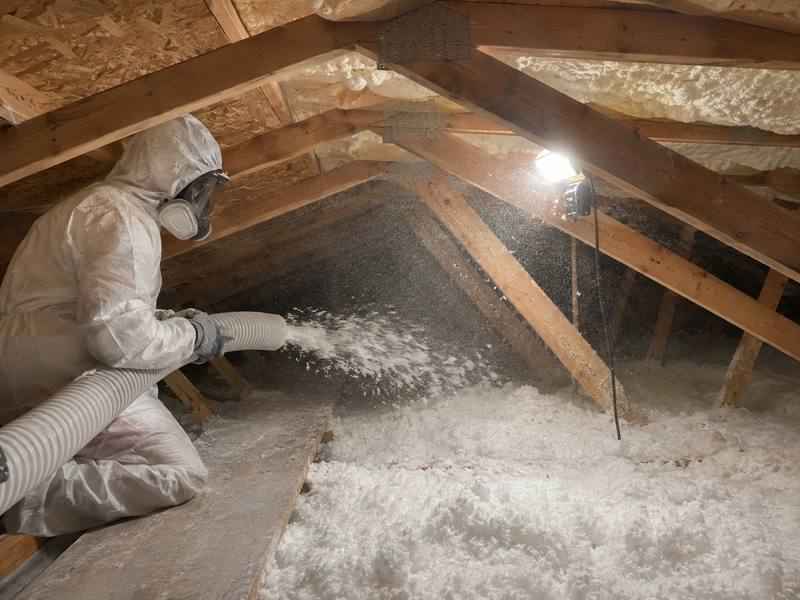
Blown-in insulation in North York attics is loose fibreglass or cellulose fed through a hose from a blowing machine and spread across the attic floor, where it fills around ceiling joists and wiring and into awkward corners that batts leave gaps at. It comes last in our order of work: first we seal the ceiling, then we set baffles at the eaves, and last we blow insulation in to full depth. This page is for you if you have an open attic over a bungalow, side-split or similar house and want it brought up to depth.
Loose fibreglass or cellulose, through a hose
Blown-in insulation, also called blowable or loose-fill insulation, comes as small loose pieces instead of rolls. The blowing machine sits outside or just inside the door, and our crew runs the hose through the house and up through your attic hatch. One person feeds the machine. The other works the hose in the attic.
On an open attic floor, loose fill insulation drops into the bays between ceiling joists and packs around wires and junction boxes. Batts have to be cut to fit around each of those, and every cut leaves a seam where heat gets past. Blown in attic insulation has no seams, so the layer ends up at an even depth across the whole floor.
There are two common materials. Blown-in fibreglass is spun glass fibre. It is light and fluffy and does not soak up water. Cellulose is shredded paper treated with a fire retardant. It is heavier and packs more tightly around obstructions. We go through the trade-offs, mineral wool included, on our page about fibreglass or cellulose for a blown-in attic.
Before the hose goes up
Sealing the ceiling and setting baffles come first, because neither can be done once the attic is full. Our crew seals the gaps around light boxes, plumbing stacks, wiring holes and the top plates of interior walls. Then we staple a baffle between the rafters at each soffit vent so air keeps moving in at the eaves. It is how we approach all our attic insulation work, and it is why we don't blow over an attic that hasn't been sealed.
Blowing to depth
Here is how the blowing goes on the day, in order.
- First, we fix depth rulers to the ceiling joists in several spots: one you can see from the hatch, others out toward the far corners. Each ruler shows the depth the product needs to reach your target.
- Then the hose goes to the farthest corners and the eaves. We fill those first and work back toward the hatch, so nobody has to crawl over fresh insulation.
- At the eaves, we keep insulation off the baffles. The baffle holds a clear channel from the soffit vent into the attic, and insulation piled on top would close it.
- Around the attic hatch, we build a dam from rigid board fastened to the joists, taller than the finished depth. When you lift the lid, the loose-fill stays behind the dam and doesn't fall into your hallway.
- Last, we fix rigid foam board to the back of the hatch lid and weatherstrip the frame. The lid is then insulated and closes tight.
The depth target from SB-12
The target comes from SB-12, the energy efficiency part of the Ontario Building Code. SB-12 asks a new Zone 1 house for R-60 over an attic ceiling in packages A1, A2, A4 and A6, and R-50 in packages A3 and A5. Those numbers are written for new houses. In an existing attic we treat them as the depth to blow toward, and our page about R-value for Ontario attics explains how to pick yours. SB-12 allows less ceiling insulation directly above access hatches and near eaves where roof slope and ventilation clearances require it, but not below RSI 3.52 directly above hatches and at the inner face of exterior walls. That is why the layer tapers down where the roof deck meets the top plates, and why the hatch lid gets its own board.
Rebates for attic insulation
Attic insulation is one of the Home Renovation Savings rebates that doesn't need a home energy assessment. Check the program's current terms before the work starts. The rules are theirs, not ours.
Settling, and reading the depth rulers later
Loose-fill settles a little after it goes in, as the fibres or paper bed down under their own weight. The product's coverage chart allows for this by listing a settled depth for each R-value. We blow past that line so the attic still reaches its R-value once the settling is done.
In a year or two, you can check the work yourself from the hatch. Bring a flashlight and a tape measure.
- Lift the hatch lid and shine the flashlight across the attic floor. You don't need to climb in.
- Find the depth ruler nearest the hatch, then look for the others out toward the corners.
- Read the mark where the top of the insulation meets each ruler. Compare it with the settled depth for your R-value on the product's coverage chart.
- Look for low spots, like a hollow where someone stepped or bare top plates near the eaves. Anywhere you can reach, push the tape measure straight down to the ceiling drywall to get a reading between rulers.
- If every reading is at or above the settled depth, leave it alone. If it has dropped below, a top-up with the same material brings it back.
Bungalow and side-split attics
A bungalow has one attic over the whole house, with low eaves along the long walls. Near the eaves the roof deck comes down close to the top plates. That is where baffles matter most, and where the hose has to reach farthest. Our page on post-war bungalow attics covers how we work in that tight space.
A side-split has separate roof sections over its different levels, and each section has its own attic space. If a section has its own hatch, it gets its own depth rulers and its own dam. If it has no hatch, we work out how to reach it before we quote. Our page on side-split attics has more on that.
Dense-pack in closed walls
Dense-pack is cellulose blown at high density into closed wall cavities through small holes, packed tight enough that it doesn't slump down the wall. Our crew drills a hole into each stud bay, feeds a narrow tube in on the end of the hose, and fills the bay from the bottom up. Then we plug and patch the holes.
It suits empty frame walls, where the cavities hold nothing but air. It doesn't suit walls that already have batts in them, because the tube can't get past the old insulation and the bay won't fill evenly. If a wall shows moisture, such as stained drywall or mould on the inside face, the source of the water has to be fixed first, by the right trade. Dense cellulose packed against wet sheathing holds that water in.
More on Blown-In Insulation
FAQ
Common questions about blown-in insulation
The bag count depends on your attic's floor area and the R-value you are blowing toward, so we work it out after measuring rather than guessing up front. Each product's coverage chart says how much floor one bag covers at each R-value. We measure the floor, check the depth already there with a tape measure, and read the count off that chart.
Yes, on an open attic floor blown-in insulation covers more evenly than batts, because it fills around joists and wiring without the seams that cut batts leave. It also reaches the low eaves without anyone crawling into them. Batts still have a place on upright surfaces like knee walls, where loose-fill won't stay put.
Yes, blown-in insulation can go on top of old insulation if the old layer is dry and free of mould or animal droppings. Wet, mouldy or rodent-damaged insulation comes out first, and we do that removal ourselves. If our crew finds vermiculite, we stop, leave it undisturbed, and recommend that a qualified lab or abatement firm test it before the job goes any further.
Yes, loose-fill settles a little after it goes in, and the product's coverage chart allows for that by listing a settled depth for each R-value. We blow past the settled line so the attic still reaches its target afterward. You can check it yourself by reading the depth rulers from the hatch with a flashlight.

Get a quote
Book an attic insulation inspection in North York
Call (437) 525-3774 or send the form. We'll look in your attic, tell you what it needs and give you a written estimate.